
Me and My Robot: Designing in the AI Era
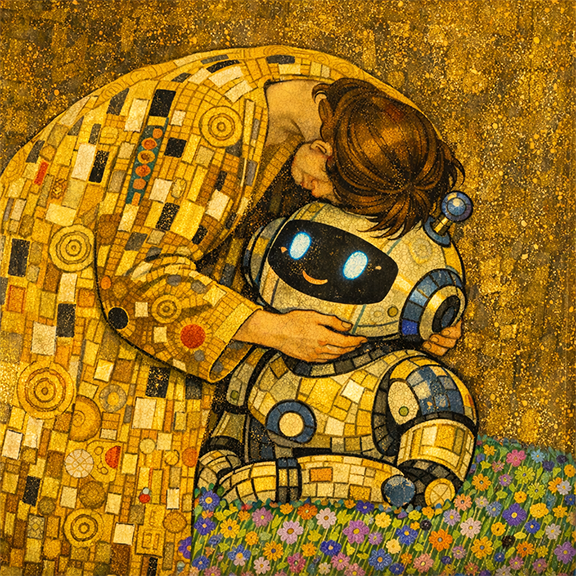
I recently read an interesting piece on It’s Nice That that asked a simple question: “What is the price of the ‘human touch’ in creativity?” The article looks at how brands are deciding whether to use “real” or artificially generated content and suggests that, for some, behind-the-scenes proof is becoming essential. People want to know you actually made the thing by hand. The creative world, it argues, is being nudged to show its workings, much like schools trying to AI-proof essay writing or brands offering “inside the factory” tours.
“As AI influences how creative work is made, we’re being asked to reconsider what we mean by human touch.”
I don’t think that argument is wrong. But I also don’t think “prove you made it” is the real pressure point I’m hearing as AI becomes more embedded in design workflows—at least not among the creatives I work with. What feels more relevant is something else entirely: we’re being asked to reconsider what we mean by human touch, and to let go of some long-held assumptions about what handcrafted is supposed to mean.
The Squeeze
Before Macs, human labor defined the creative process. As AI compresses time and production today, distinction comes from human intervention, not from proving how something was made.
AI can already generate competent, fast, inexpensive design, and in many cases, “good enough” is good enough for organizations that just need content in market quickly—images and copy for slide decks, email graphics, or social posts. (No value judgment there.) So when we talk about the price of human touch, money often becomes the decision driver. And money, in this context, is shorthand for time, accountability, experience, quality, and taste.
There is a squeeze happening. What’s disappearing fast is the middle: work that isn’t cheap enough to compete with automation and isn’t strategic enough to justify senior-level involvement. Designers who only offer execution will struggle. Clients who were price-sensitive before will be even more so now. They won’t pay extra just because something is handcrafted.
Craft as a Signal
There’s also a cultural premium at play. Some design is valued precisely because it’s human-crafted—not as nostalgia, but with intent. You can feel it in creative work that’s meant to be tactile, personal, or intentionally unoptimized. (The It’s Nice That article highlights some beautiful examples.)
“Not everyone buys sourdough, but the people who do probably aren’t hanging out in the Wonder Bread aisle. The same dynamic shows up in design.”
It’s similar to what happened with food. Industrial food became cheap and fast. Artisanal food became symbolic, and people were willing to pay more for it. Not everyone buys sourdough, but the people who do probably aren’t hanging out in the Wonder Bread aisle. The same dynamic shows up in design. Human touch becomes a signal of values and priorities, not just a method of production.
Taste Matters
Taste has always been an economic asset, but it’s becoming harder to ignore, which can sound lofty until you remember how human the creative industry really is. I landed my first job because my future boss liked what I wore to the interview. But taste is more than style. It’s discernment formed through success and failure, shaped by culture, emotional intelligence, and foresight earned through experience. Taste shouldn’t be underestimated.
As AI makes it easy to generate endless options, selection becomes the creative act. Knowing what to keep, what to discard, and what never should have been made in the first place carries a different kind of power. That’s curatorial power layered on top of design skill. It’s the counterweight to AI’s endless expansion.
“Technological shifts shouldn’t be judged using criteria built for the world we’re leaving behind. Those criteria are shaped by the world we’re entering.”
Craft, Redefined
When the Mac arrived in the 1980s, it rewired the design industry. The center of gravity shifted from hands and pencils to screens and software. Early tools like PageMaker raised fears about automation and replacement. But those fears missed the scale of what was actually happening.
Fear tends to narrow perspective, but when panic recedes, the industry doesn’t close down—it opens up. Designers who learn to judge change on its own terms, rather than through the lens of what’s being lost, are better positioned to find where they belong in what comes next. Technological shifts shouldn’t be judged using criteria built for the world we’re leaving behind. Those criteria are shaped by the world we’re entering, and they aren’t always obvious.
The tech shift of the 1980s wasn’t the death of craft. Craft still influenced how people accessed information and connected emotionally to products, people, and organizations. Technical skills changed. Workflows changed. Speed-to-market changed. Craft didn’t become less meaningful; it moved upstream into system design and experience design, into style guides and brand platforms. That’s why I don’t buy the “AI is a threat to design” narrative. I’ve seen this movie. The plot twists. The cheese moved. Craft didn’t die.
“AI is good at producing options. It is bad at owning consequences.”
Craft isn’t only what your hands can do. It’s how you curate creativity. It’s the discipline to protect meaning when AI tools make it easy to generate something shiny and seductive. It’s how you hold a standard when speed or budgets tempt you to lower it.
Judgment and Stewardship Under Uncertainty
AI is good at producing options. It is bad at owning consequences. Judgment and stewardship need to be taught, modeled, and mentored with intention to early- and mid-career designers, writers, and strategists.
As automation makes iteration and production faster and more accessible, there will absolutely be a need for experts who excel on the technical side of working with AI tools—the Photoshop gurus and prompt masters. But creative control still lives upstream, before technical execution.
“AI can’t negotiate between Marketing and Sales, coach a junior designer through uncertainty, or advise a client when they’re about to make a bad decision.”
Human touch shows up in how creative decisions are defended, how feedback is negotiated, and how competing inputs are synthesized into a cohesive direction. It’s knowing when to push, when to hold, and when to say no. It’s the ability to build consensus between Marketing and Sales, coach creative teams through uncertainty, and advise clients when they’re about to make a bad decision. This is what clients are paying for when they hire senior creatives—consultants like me. You won’t see it by scrolling through a portfolio.
Where This Leaves Us
Many warn that AI is democratizing creativity. It’s not all bad. Creative iteration is faster. In many cases, especially with video, work is much cheaper. But while it’s made “good enough” almost effortless, what it democratizes is access to iteration, not access to authority.
Human touch shows up in the moment a designer says, “This is the best option for these reasons. This is what we’re willing to stand behind. And this is what it will cost to do it with integrity.” Authority still belongs to people who can persuade, take responsibility, and operate inside messy human systems. AI doesn’t flatten that. If anything, it elevates it.
That’s where the craft of design is heading. If I’m being honest, it’s probably where it’s always been, even if we’re still catching up to it.
P.S. For the record, all the em dashes in this article are of my own doing. :)